Aura
Agentic coding CLI.
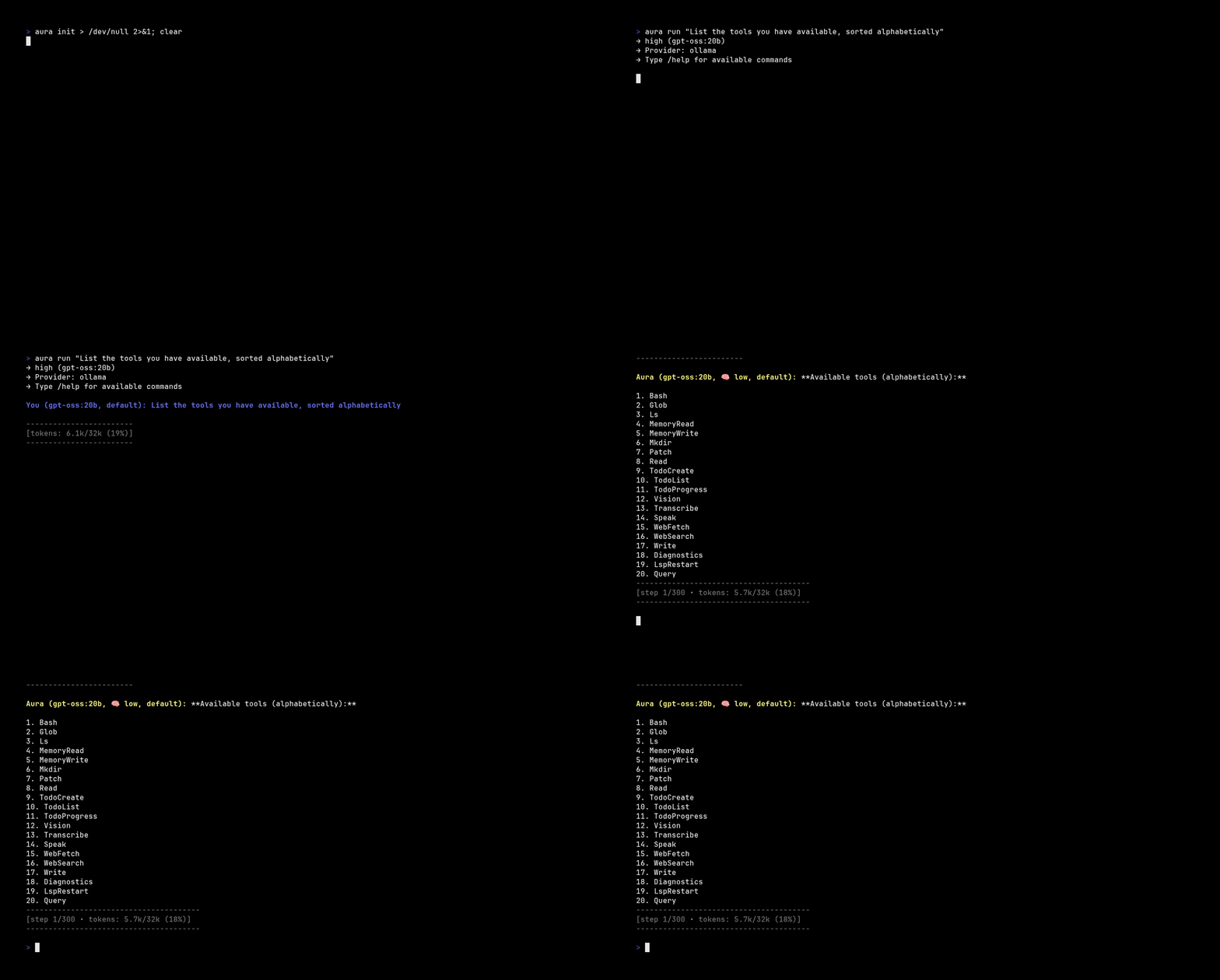

aura is a terminal-based coding assistant that connects to local or remote LLMs. Agents, tools, modes, guardrails, and providers are defined as YAML and Markdown files.
# Start interactive session
aura

# One-off prompt
aura run "Write a Go function that reverses a string"

# Embedding-based codebase search
aura query "token counting"

# List available models
aura models
Task Orchestration
Tasks are YAML files that sequence prompts, slash commands, and shell commands. /assert and /until add condition gates — the LLM keeps working until the condition is satisfied.
build-app:
  agent: high
  timeout: 60m
  commands:
    - /mode plan
    - Read SPEC.md and generate a plan.
    - /until not todo_empty "Create the plan with TodoCreate"
    - /mode edit
    - /auto on
    - Execute the plan.
    - /until bash:"go build ./..." "Build is failing. Fix the errors."
Tasks support cron scheduling, foreach iteration over files or shell output, pre/post shell hooks, session continuity across runs, and template variables. See Examples for more patterns.
Providers
Aura connects to local and remote LLM providers. No single vendor required — switch providers per agent, per task, or at runtime.
- Ollama
- LlamaCPP
- OpenRouter
- OpenAI
- Anthropic
- Copilot
- Codex
Configuration
Everything is file-based YAML and Markdown. Agents, modes, prompts, hooks, and tasks support inherit: with DAG-based resolution
Extensibility
Go plugins — interpreted Go code (Yaegi) with lifecycle hooks at 8 timings, custom tools with sandbox integration, and custom slash commands. Distributed via git with vendored dependencies.
Features
| Feature | Description |
|---|---|
| Agents | Per-agent model, provider, system prompt, and tool filters |
| Tools | Built-in tools + custom tools via Go plugins |
| Modes | Tool availability and bash command restrictions |
| Guardrails | Secondary LLM validation of tool calls and user messages |
| Slash Commands | Built-in + user-defined as Markdown files |
| Skills | Model- and user-invocable capabilities with progressive disclosure |
| Compaction | Automatic context compression via dedicated agent |
| Embeddings | Embedding-based codebase search with AST-aware chunking |
| Sessions | Save, resume, and fork conversations |
| Sandboxing | Landlock LSM filesystem restrictions |
| MCP | HTTP and STDIO transports |
| Thinking | Extended reasoning with configurable levels |
| Vision | Image/PDF analysis via vision-capable model delegation |
| Audio | Speech-to-text transcription and text-to-speech synthesis |
| Hooks | Shell commands before/after tool execution |
| LSP | Language server diagnostics appended to tool results |
| Plugins | User-defined Go plugins via Yaegi interpreter |
| Memory | Persistent key-value storage across sessions |
| Deferred Tools | On-demand tool loading to reduce initial context usage |
| Scheduled Tasks | Cron-based task scheduling with foreach iteration |
| Web UI | Browser-based chat interface with SSE streaming |
| Auto Mode | Continuous execution with condition gates and Done tool |